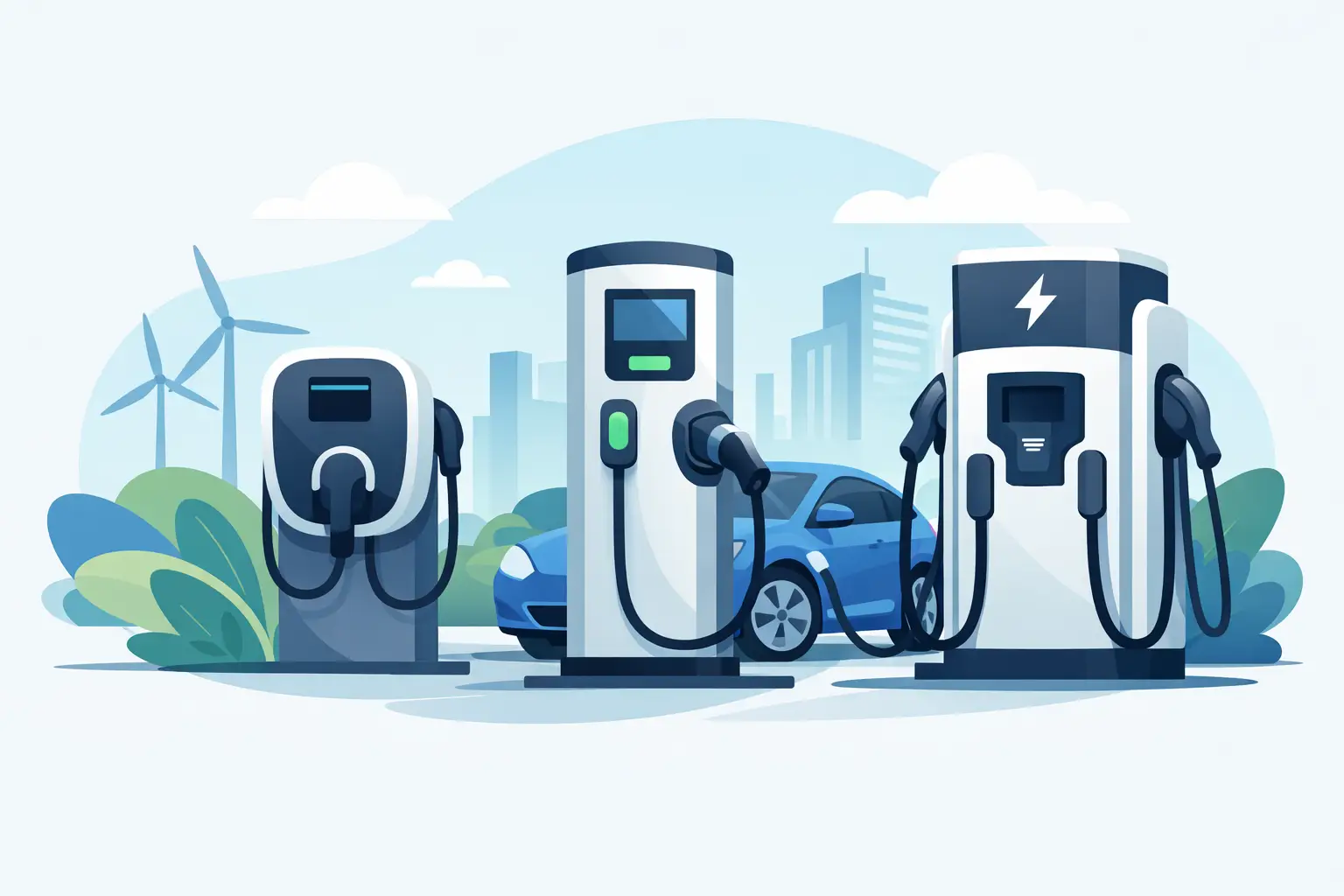
Pull into a public station with 12 plugs, three pricing schemes, and two speed labels, and the question gets real fast: what are the different types of EV chargers, and which one should you actually use? For most drivers, the confusion is not about whether charging works. It is about speed, compatibility, and cost at the moment you need power.
The short answer is that EV chargers fall into three main categories: Level 1, Level 2, and DC fast charging. That sounds simple. In practice, each type comes with trade-offs in charging speed, hardware, availability, and price, and those differences matter a lot more on a road trip or a low-battery day than they do in a brochure.
What are the different types of EV chargers?
The easiest way to think about charger types is by how much power they deliver and where you are likely to use them.
Level 1 charging is the slowest. It usually means plugging your EV into a standard household outlet. Level 2 charging is much faster and is common at homes, workplaces, hotels, apartments, and public parking lots. DC fast charging is the quickest option for public charging and is mostly used when you need a meaningful battery boost in a short stop.
Those are the big buckets, but they do not tell the whole story. Connector type, your car’s onboard charging limit, battery temperature, and station pricing all affect the real result.
Level 1 charging
Level 1 uses a standard 120-volt outlet. In most cases, that is the slow charger that comes with the vehicle or an optional portable cord set. It is the most accessible option because it does not require special installation, but it is also the least practical if you drive a lot.
A Level 1 charger typically adds around 3 to 5 miles of range per hour, though the exact number depends on the vehicle and conditions. For a plug-in hybrid or a low-mileage commuter, that can be enough. For a fully electric SUV driven daily, it often is not.
The real value of Level 1 is convenience and backup. If you have overnight parking and modest daily miles, it may cover your needs. If you regularly arrive home low and need a full recharge by morning, it will feel painfully slow.
Level 2 charging
Level 2 uses 240-volt power, similar to what large home appliances use. This is the charger type most EV owners end up relying on for everyday charging because it hits the sweet spot between speed and cost.
A typical Level 2 charger adds roughly 15 to 40 miles of range per hour. Some vehicles charge on the lower end, some on the higher end, and the station’s power output matters. A 7.2 kW station and an 11.5 kW station are both Level 2, but they do not perform the same.
At home, Level 2 is usually the most practical setup. Publicly, it is common in places where your car will sit for a while, such as offices, garages, shopping centers, and hotels. If you are planning around errands or an overnight stay, Level 2 often makes more sense than waiting at a fast charger that costs more per kWh or per minute.
DC fast charging
DC fast charging, sometimes called Level 3, is built for speed. Instead of sending AC power to the car’s onboard charger, it sends DC power directly to the battery. That bypass is what makes fast charging possible.
Depending on the station and the vehicle, DC fast charging can add about 100 to 200-plus miles of range in 30 minutes. That sounds straightforward, but real-world results vary a lot. A charger labeled 150 kW does not mean your car will actually pull 150 kW. Many cars peak for a short period, then slow down as the battery fills or heats up.
This is the charger type you want on road trips, tight schedules, or unexpected low-battery situations. It is also usually the most expensive public option, so using it for every session is rarely the cheapest strategy.
The different types of EV chargers by connector
When drivers ask what are the different types of EV chargers, they are often really asking about plugs. That is a separate issue from charging level, and it is where a lot of confusion starts.
For Level 1 and most Level 2 charging in North America, J1772 has long been the standard connector for non-Tesla vehicles. Tesla drivers traditionally used their own connector with adapters depending on station type, though the market is shifting as more automakers and networks move toward NACS, the North American Charging Standard.
For DC fast charging, the two names you will hear most are CCS and NACS. CCS has been common across many non-Tesla EVs. NACS started as Tesla’s connector but is rapidly becoming a much broader standard. CHAdeMO still exists on some older vehicles and stations, but it is fading from the mainstream market.
This matters because a fast charger is only useful if your car can connect to it. Speed means nothing without compatibility.
J1772
J1772 is primarily used for AC charging, which means Level 1 and Level 2. If you drive a non-Tesla EV from the last several years, there is a good chance you have used this connector.
CCS
CCS combines the J1772 upper section with two extra DC pins below it. It supports DC fast charging and has been the main standard for many U.S. and Canadian EVs outside the Tesla ecosystem.
NACS
NACS is compact and increasingly important. More automakers are adopting it, more public chargers support it, and adapter availability is improving. If you are shopping for an EV now, NACS matters more than it did even a year or two ago.
CHAdeMO
CHAdeMO is mostly relevant if you drive an older Nissan Leaf or another older EV that uses it. Availability is shrinking, so owners of CHAdeMO vehicles need to plan public charging more carefully.
Charger speed is not the same as charger type
A big mistake is assuming that the highest number on a charger means your car will charge that fast. It depends.
Your EV has its own limits. On Level 2, the car’s onboard charger may cap the speed regardless of the station’s capability. On DC fast charging, battery chemistry, state of charge, and temperature all affect power intake. A battery at 10 percent may charge quickly. The same battery at 80 percent usually slows down a lot.
That is why charging from 10 to 60 percent is often much quicker than charging from 80 to 100 percent. The last stretch takes longer, and at a fast charger it is often the least cost-effective part of the session.
Which EV charger type makes the most sense?
If you charge at home and have dedicated parking, Level 2 is usually the best long-term answer. It is fast enough for daily life without the premium cost of relying on public fast charging.
If you live in an apartment, park on the street, or mainly charge away from home, the best charger type depends on your routine. Level 2 works well if your car sits for hours. DC fast charging works when you need speed, but frequent use can cost more and requires more planning.
Level 1 is best treated as the slow, simple option. It is not useless. It is just limited. For some drivers, that is fine. For others, it becomes a daily bottleneck.
Cost changes the equation
The fastest charger is not always the smartest charger. Public charging prices vary by network, location, and billing method. Some stations charge by kWh, others by time, and some add session fees or parking costs. Two nearby chargers can have very different real prices even when they look similar on the map.
That is where comparing stations across networks matters. A driver-first app like WattsNear is useful because charger choice is rarely just about finding a plug. It is about finding a compatible plug at a reasonable price without opening five different network apps and guessing which one will actually be cheaper.
For a grocery stop or a movie, a lower-cost Level 2 station may be the better move. For highway travel, paying more for DC fast charging can be worth it because your time matters too.
The best way to think about EV charger types
Do not think of chargers as better or worse in the abstract. Think of them as tools for different jobs.
Level 1 is the backup and low-mileage option. Level 2 is the everyday workhorse. DC fast charging is the time-saver when you are away from home or covering serious distance. Then layer in connector compatibility, your vehicle’s charging limits, and actual station pricing.
Once you look at chargers that way, the category names stop being jargon and start being useful. And when you are standing in a parking lot with 18 percent battery left, useful beats complicated every time.