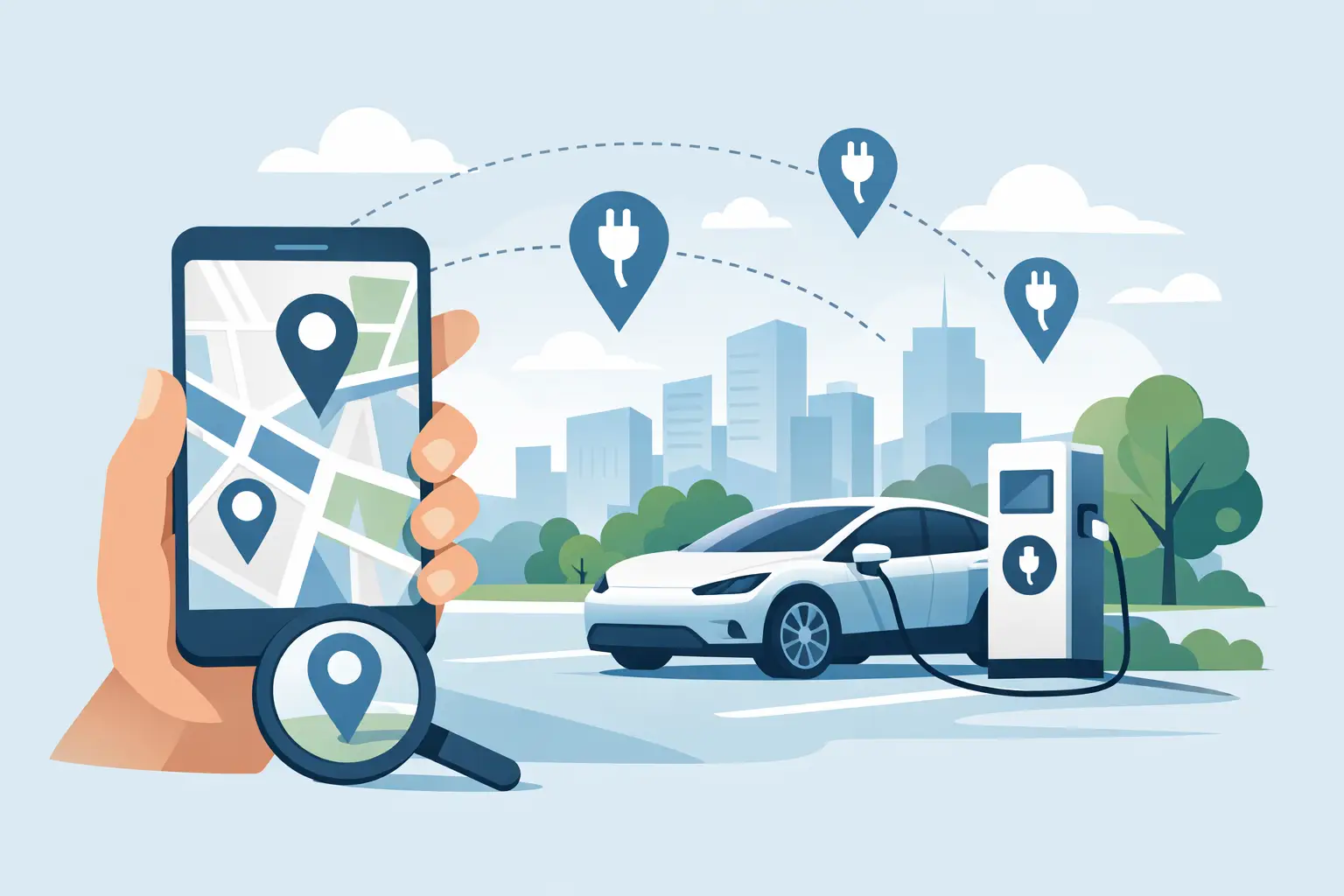
You’re at 18%, traffic is worse than expected, and the charger you used last week is suddenly a bad option. That’s the real moment behind searches like nearby ev chargers near me. You are not doing research. You are trying to make a fast, low-risk decision before range anxiety turns into wasted time.
That is why charger discovery should be simple: what is closest, what is cheapest, and what is likely to work for your car right now. Too many charging apps make that harder than it needs to be. They push a single network, bury pricing, ask for an account before showing useful info, or treat station discovery like a marketing funnel. Drivers need the opposite.
What people really mean by nearby EV chargers near me
Most drivers are not literally asking for the nearest plug on a map. They are asking a more useful question: where can I charge next with the least friction?
Sometimes the closest station is not the best station. A charger half a mile closer may cost significantly more, be slower, or require crossing a busy interchange and doubling back. A station that looks convenient can also be limited to a network you do not usually use, or have pricing that only makes sense after session fees, idle fees, or time-based rates are factored in.
So when you search nearby EV chargers near me, you are really balancing four things at once: distance, price, speed, and compatibility. The best charger is usually the one that gets you back on the road fastest at a fair cost, not the one that happens to sit nearest your current pin.
Why charger apps often waste your time
Most public charging apps were not built to compare the whole market. They were built by networks to fill their own stations. That creates a blind spot right where drivers need clarity.
A network-owned app naturally highlights its own chargers first. That is useful if you already know exactly which brand you want. It is less useful when you just need the best option nearby. You end up checking multiple apps, zooming around multiple maps, and trying to translate inconsistent pricing formats into something you can compare.
That friction matters more than people admit. Public charging decisions are often made in parking lots, on unfamiliar routes, or during tight schedules. Every extra login, every missing price, every hidden filter adds delay when the decision should take seconds.
There is also the privacy side. Many apps collect more data than they need for a simple charger search. If all you want is a nearby station and a rough idea of cost, you should not have to trade that for an account, ongoing tracking, or a cluttered ad-tech experience.
How to find the right charger nearby, not just any charger
The practical move is to rank chargers by the same factors you use in the real world. Start with distance, but do not stop there.
Check usable proximity, not raw map distance
A charger can be technically close and still be inconvenient. Think in driving minutes and route fit, not just straight-line distance. If a station requires a long detour, awkward turn, or paid garage access, it is not really nearby in any meaningful sense.
For commuting, the best nearby charger is often one that fits your existing path. For road trips, it is the station with the least off-route time. For city driving, it may be the charger that avoids garage fees or impossible parking.
Compare price in a way that actually helps
This is where many drivers lose money. Public charging prices are not always presented clearly. Some stations charge by kWh, others by time, and some add session or parking fees. If you are comparing chargers across networks, raw price labels can be misleading.
What matters is your likely charging cost for this stop. A higher posted rate at a faster charger may still be worth it if it saves 20 minutes. On the other hand, if you are topping off while shopping or eating, the cheaper slower option may be the smarter choice. It depends on whether your priority is total cost or total time.
Make sure the charger fits your car and charging goal
Connector type is the first gate. After that, charging speed matters based on your battery level and schedule. A quick top-up on DC fast charging solves a different problem than a longer Level 2 session while parked.
Newer EV drivers often overfocus on peak charging speed. The better question is whether the station matches the stop you are making. If you only need enough range to get home, paying a premium for the fastest possible charger may not make sense.
The hidden cost of checking multiple charging networks
If you have ever compared stations manually, you already know the problem. One app shows a charger three minutes away but no price. Another shows price but only for its own network. A third has better map detail but stale station info. By the time you piece it together, the easy decision has become a chore.
This is exactly why aggregated charger search is more useful than network-by-network browsing. A single view across major charging networks lets you compare the options that actually compete with each other. That is better for the driver because it reflects the real decision: which station nearby gives me the best outcome right now?
A driver-first tool should also make pricing readable. If network data comes in different formats, the app should do the work of parsing it into estimates that normal people can compare. That is more honest than pretending every posted rate means the same thing.
Nearby EV chargers near me should answer two questions fast
When drivers need a charge, most of the noise falls away. The screen should answer two things immediately: how close is it, and how much will it cost?
Everything else is secondary until those answers are clear. Not because connector types, power levels, or network names do not matter. They do. But distance and cost are what narrow the field to two or three realistic choices.
That is the logic behind a simpler search experience. One app, one map, live station data, useful sorting, and no account wall before you can get basic answers. WattsNear takes that approach because it reflects what drivers are trying to do under pressure, especially on iPhone and CarPlay where speed matters.
When the nearest charger is not the best value
There are a few common cases where “nearest” loses.
The first is expensive fast charging during a non-urgent stop. If you are already parked for 45 minutes, a lower-cost charger nearby can beat the absolute closest one.
The second is poor route alignment. A station that is slightly farther away but directly on your path usually saves more time than a closer charger that requires backtracking.
The third is pricing ambiguity. If one charger clearly shows a reasonable estimate and another hides the real cost behind membership details or fragmented pricing, the transparent option is often the better bet. Predictability matters when you are away from home.
And then there is availability risk. Even with live data, station status can change. That is why it helps to keep a second-best option in mind, especially in busy corridors or holiday traffic. Smart charging is not just finding one charger. It is making a choice with a backup.
What a better nearby charger search looks like
A useful nearby charger search should feel almost boring. Open the app. See stations across networks. Sort by distance or price. Check the connector and speed. Make a decision. Drive.
That sounds basic, but it is surprisingly rare. Many charging tools still assume the user wants to browse a specific ecosystem, sign in, or spend time learning the interface. Drivers usually do not. They want the shortest path from low battery to useful answer.
That is also why privacy matters here. Charger discovery is a utility task, not a social platform. No account, no tracking, and no profiling is not just a philosophical stance. It removes friction. If an app can help you find nearby charging without turning the moment into a data collection event, that is simply a better product.
The best search is the one that respects the moment
Public charging is rarely a leisurely decision. You may be late, in an unfamiliar area, or trying to avoid overpaying for a quick top-up. A good charger search tool respects that reality.
It does not trap you inside one network. It does not hide pricing behind vague labels. It does not ask for more data than it needs. It gives you a clear view of nearby options and lets you choose based on what matters now.
The next time you search nearby ev chargers near me, treat it like what it really is: a live comparison problem. The faster you can compare distance, cost, and fit in one place, the less time you spend staring at maps and the more time you spend driving.