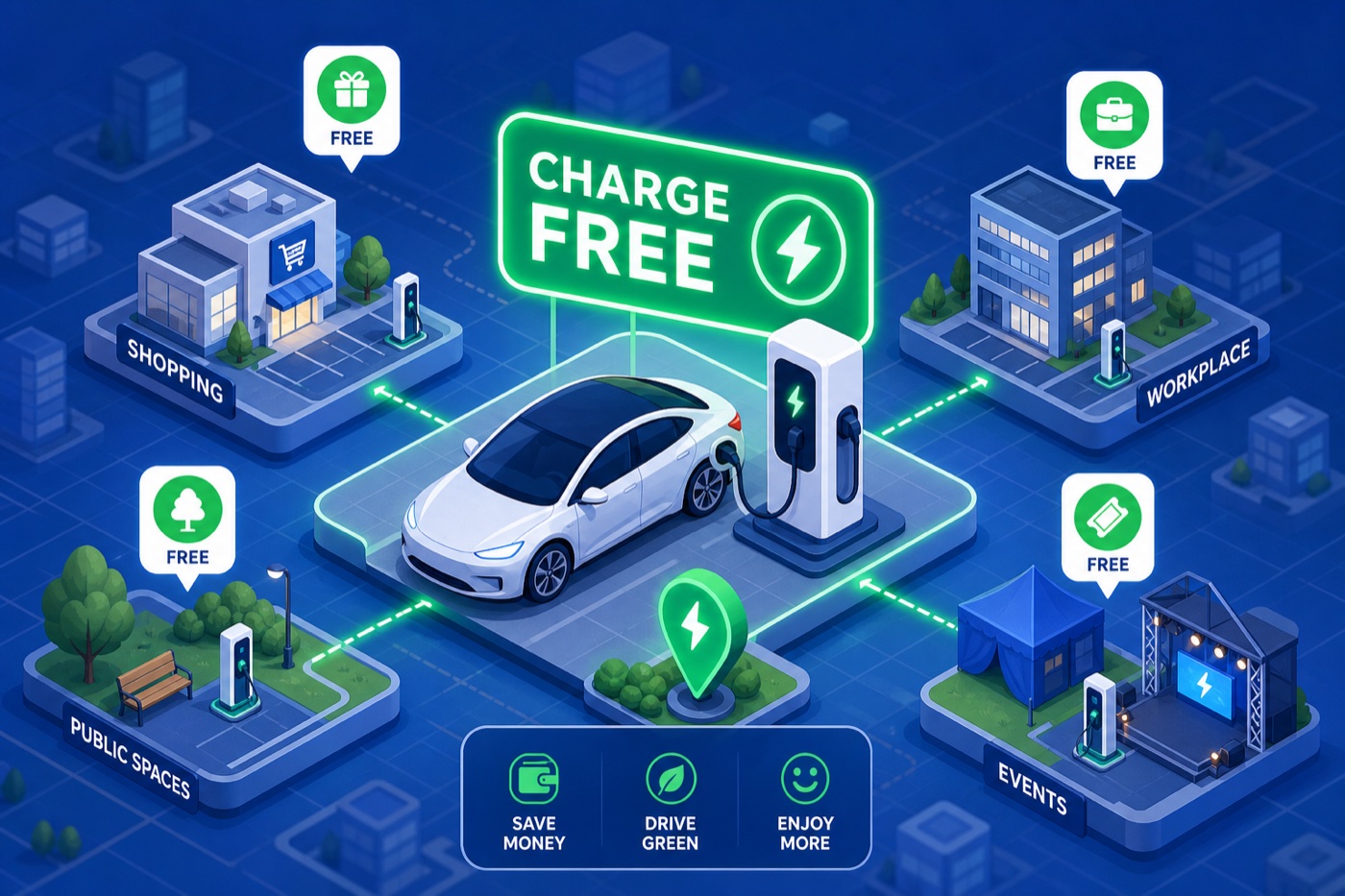
Free electric car charging is more common than most EV drivers realize, but it doesn’t live where people expect it. There’s no national policy, no standard perk that comes with every charger. It shows up in parking lots, hotel garages, employer campuses, and the occasional retail store, and most drivers walk right past it because they don’t know what to look for. Prevalence also varies by region: urban corridors and states with strong utility programs tend to have far more options than rural areas, and the numbers look different depending on whether you’re counting locations or individual ports.
The tools have caught up, though. WattsNear lets you filter specifically for stations that cost nothing, pulling live data from the U.S. Department of Energy’s NREL Alternative Fueling Station database without needing an account or a subscription. That changes how accessible this actually is. Once you know which categories to target and what strings are attached, free electric car charging stops being a nice surprise and starts being a regular part of your routine.
This article covers exactly that: where complimentary charging actually shows up, what limits come with it, which tools surface it fastest, and how to use it without annoying everyone else at the charger.
Where free public chargers actually show up
Most no-cost public charging lives at Level 2 stations inside businesses that want you nearby for a while. That’s the core logic. The business absorbs a small electricity cost in exchange for foot traffic, dwell time, or brand goodwill. Understanding that logic tells you exactly where to look.
Free electric car charging at retailers, hotels, and workplaces
IKEA is one of the most widely cited examples in the U.S., with EV charging available at most domestic locations, though whether each site is free or paid varies, so verify via the AFDC or your preferred charging app before you go. Some Whole Foods and grocery stores have offered complimentary Level 2 stations in select markets, but availability shifts by location and operator, so check app listings for specifics. Mall parking with ChargePoint or Volta-managed stations has historically included free access, but the Volta network shifted away from its ad-supported free model after Shell’s 2023 acquisition, so confirm current status before counting on it.
The overall numbers are sobering. According to Consumer Reports, only about 1% of the roughly 270,000 retail and fast-food sites in the U.S. offer any EV charging at all, and free-only is a subset of that already small slice. Knowing which store categories to target, and verifying before you drive there, is the only reliable approach.
Hotels, workplaces, and parking garages
Hotels along major travel corridors are a consistent source of complimentary Level 2 charging. Most list their stations in EV apps, and many offer free access to guests as a standard amenity. Employer-provided charging is still common and often completely free, especially at tech campuses and larger corporate offices. Public parking garages in metro areas sometimes include free chargers as part of smart city or utility-subsidized programs, and these spots go unnoticed because they don’t advertise loudly.
A parking garage two blocks from your office might have two free Level 2 stalls open all day. The only way to find out is to check.
Free Level 2 vs. free DC fast charging: what to realistically expect
There’s a common misconception that “free charging” means fast charging. It almost never does. Understanding the split helps you plan around what’s actually available rather than what you wish were available.
Why free charging is almost always Level 2
Level 2 charging, which delivers roughly 3 to 19 kW and works best for stays of an hour or more, makes sense as a free perk because the electricity costs are manageable and the business keeps you on-site longer. Roughly 70% of U.S. public chargers are Level 2, and around 25 to 35% of those stations offer free access depending on location and operator. It’s the dominant tier for no-cost public charging by a wide margin.
When free DC fast charging actually exists
Free DC fast charging is genuinely rare, representing under 5% of fast chargers in the U.S. It shows up in a few specific situations: automaker partnership promotions with networks like Electrify America, utility-subsidized highway pilots in states like Washington and Oregon, and occasional trial periods at newer commercial hubs. Useful when it exists, but not reliable enough to build a charging strategy around.
Automaker perks and utility programs worth checking
Before hunting for public free chargers, check whether your vehicle already came with complimentary charging access you haven’t activated. A lot of drivers skip this step entirely.
Checking your vehicle’s charging perks
Several automakers still bundle Electrify America credits with new purchases. BMW iX, i4, and i5 owners receive two years of 30-minute fast charging sessions. VW ID. model buyers get up to 500 kWh per month for three years. GM vehicles, including select Chevy and GMC models, come with up to 1,000 kWh over three years. Tesla’s legacy “free Supercharging for life” still applies to early Model S and Model X owners, though it’s tied to the original purchaser and doesn’t transfer. Check your vehicle’s ownership portal or the Electrify America app with your VIN to confirm what applies to your specific car.
These perks expire and carry restrictions. Most Electrify America sessions cap at 30 minutes and cut off at 85% state of charge at busy locations. Idle fees of $0.40 per minute kick in after a 10-minute grace period. Knowing the limits prevents bill shock when you expect a free session and get charged for staying too long.
Utility and regional programs to look up
BGE (Baltimore Gas and Electric) in Maryland runs an EVsmart program that includes subsidized or free stations for customers. Similar utility-backed programs exist through LADWP in California, ConEd pilots in New York, and Xcel Energy in the mountain and plains states. These are regional by design and worth checking against your local utility’s EV page, especially if you live near major NEVI corridors like I-95 or I-5 where infrastructure investment has been highest.
The fastest way to find free electric car charging near you
Many drivers open a general EV charging map and scan manually for pricing information. That works, but it takes time and misses stations where pricing data isn’t consistently updated. A free-only filter cuts straight to what matters.
Using a free-only filter to skip the guesswork
WattsNear’s built-in free-only filter is a fast way to surface no-cost stations. It pulls live data from the DOE’s NREL Alternative Fueling Station database and shows complimentary stations nearby in seconds. No account creation, no personal data required. Toggle the free-only filter and see what’s available. For drivers who want community-verified status on top of database listings, PlugShare adds user check-ins and reviews that help confirm whether a station listed as free is still actually free.
The combination of a reliable filter and recent user reviews eliminates most wasted detours. Free status changes — a station that was complimentary six months ago may have switched to a paid model since the last database update. Cross-referencing both sources takes thirty seconds and can save a twenty-minute detour.
What to double-check before you pull in
Before routing to any free station, confirm the connector type matches your vehicle. A free CCS charger is worthless if your car uses NACS, and vice versa, and with the industry’s ongoing connector transition still underway in 2026, this is worth checking every time rather than assuming. Also review recent activity on that station: if the last user check-in was three months ago and shows it broken, that’s a red flag worth heeding. WattsNear lets you filter by connector type alongside the free-only toggle, so results stay relevant to your specific car from the start.
What to know before you plug in: restrictions and etiquette
Free charging has more fine print than most drivers read, and ignoring it can cut your session short or generate fees on what you expected to be a no-cost stop.
Time limits, idle fees, and kWh caps
The most common restrictions on complimentary charging programs include 30-minute session caps on DC fast chargers and 85% state-of-charge cutoffs at high-traffic Electrify America locations. Retail Level 2 spots typically carry informal two- to four-hour limits, and some charge idle fees once your car stops drawing power. Promotional kWh allotments, like the 250 kWh over three years offered with some Hyundai models, deplete faster than most owners expect if they rely on them as a primary charging strategy.
Treat these perks as a supplement, not a foundation. Use them when you’re already stopping somewhere, not as the reason you’re going there.
How to use free spots without being that driver
Free public charging works better for everyone when people cycle through efficiently. Unplug as soon as your charge completes. Don’t occupy a free Level 2 spot as long-term parking if there’s a line. At retail locations, move your car once you’re done shopping, even if the time limit technically hasn’t expired. These habits keep spots functional and available, and in some municipalities, misuse of EV charging spaces carries fines that make a free charging session considerably less free.
Making free electric car charging part of your regular routine
Free electric car charging is real, accessible, and more useful than most drivers give it credit for once they know where to look and how to filter for it. Level 2 at retail stores, hotels, and workplaces covers most daily top-up needs. Automaker perks cover road trips for eligible owners. The gap between knowing free charging exists and actually finding it quickly comes down to using the right tool.
WattsNear handles that part without a signup or subscription. Open it, filter for free stations, and see what’s near your current location or your next stop. It works from your iPhone home screen or your CarPlay display while you’re already on the road.
Start with your regular stops: the grocery store you already visit twice a week, the parking garage near your office, the hotel on your next road trip. Free EV charging stations are hiding in plain sight at most of those places. The trick is knowing how to surface them before you park, not after.