You’re standing at a highway charging plaza. Two DC fast chargers sit side by side: one rated at 50 kW, one at 150 kW. The faster option costs more per kWh, but it’s three times the power. The choice seems obvious — until you realize your car might not actually be able to use that extra power.
This is where most EV drivers make a guess. A few understand what’s really happening. A charger’s kW rating tells you one thing: the maximum rate at which it can deliver energy. Whether your car can absorb that energy, and for how long, is a different question entirely.
Knowing how a charger’s kW rating affects charging speed doesn’t just make you a more informed buyer. It makes every charging stop faster, cheaper, or both. Apps like WattsNear already show you real-time cost-per-kWh data across nearby stations, but understanding the kW side of the equation is what helps you make sense of those numbers before you commit to a stop.
How a charger’s kW rating affects charging speed
kW measures rate, kWh measures total energy
Think of a garden hose. The water pressure is your kW — the rate at which water flows. The total water that ends up in the bucket is your kWh. One measures flow rate; the other measures volume delivered over time. They’re related, but they answer different questions.
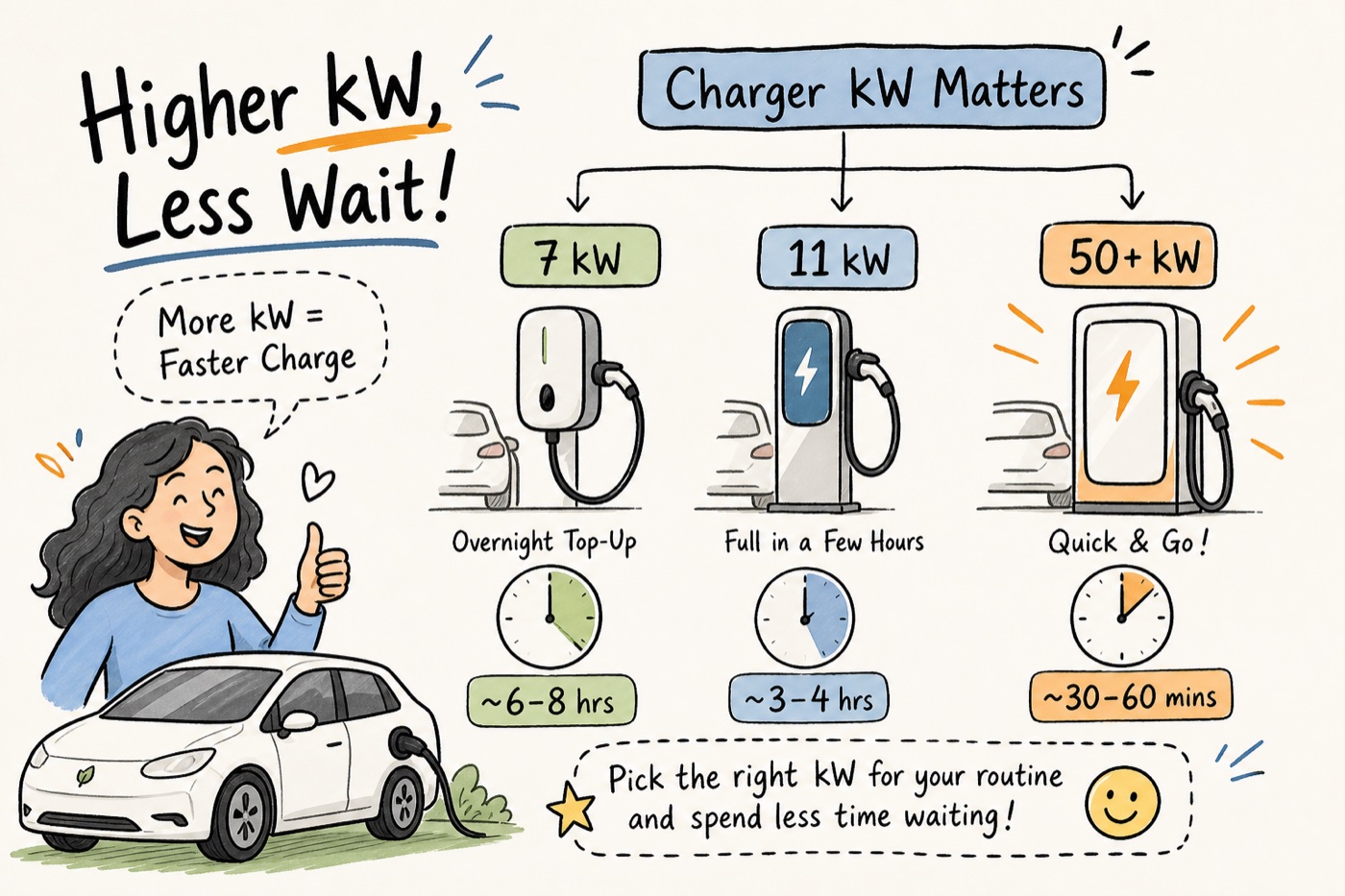
In practical terms, a 7 kW charger pushes 7 kilowatt-hours of energy into your battery every hour (accounting for minor losses). A 50 kW charger pushes 50 kWh per hour. For an EV with a 60 kWh battery, that’s not a marginal difference. It’s the gap between a quick stop and a long wait.
The charging time formula is simpler than it looks
You don’t need a spreadsheet to estimate charging time. The core equation: charging time in hours equals battery capacity (kWh) divided by charger power (kW). Take a 60 kWh battery at 20% state of charge targeting 80%. That’s 60% of 60 kWh, or 36 kWh to add. At 7 kW, that takes just over 5 hours. At 50 kW, it takes roughly 43 minutes.
Add a 5–10% buffer for real-world efficiency losses and your estimates stay accurate without overcomplicating things. That gap between 7 kW and 50 kW is the whole point of this section.
Where volts, amps, and power delivery fit in
Charger power (kW) is volts multiplied by amps, divided by 1,000. A 240V circuit at 32A, for example, delivers 7.68 kW — that’s the math behind most home Level 2 installs. Level 2 chargers run on 240V AC and deliver between 3.3 kW and 11.5 kW depending on amperage. DC fast chargers skip the car’s onboard AC-to-DC converter entirely and push power directly into the battery at much higher voltages, which is why their power levels can reach 50, 150, or even 350 kW. Understanding this watts-and-amps relationship is what separates a charger’s nameplate number from the power delivery your battery actually receives.
Level 2 vs. DC fast chargers: the real numbers
What 7.2 kW looks like on an actual charge stop
Picture a 75 kWh EV at 20% state of charge. You want to reach 80% before heading back out. That’s 45 kWh to add. At 7.2 kW, accounting for typical efficiency losses, you’re looking at roughly 6.5 hours. That’s a realistic overnight home charge or a long stop at a shopping center. Level 2 public stations are usually the cheapest per kWh, which matters when time isn’t the constraint.
What 50 kW and 150 kW DC fast chargers actually change
Same battery, same 20-to-80% scenario. At 50 kW, you’re done in under an hour — closer to 50 minutes on a good day. At 150 kW (assuming your car can accept it, which we’ll cover next), that window shrinks to roughly 20–25 minutes. These are not marginal improvements. On a long road trip, the gap between 50 kW and 150 kW is the difference between a quick coffee and a full sit-down meal.
How a charger’s kW rating affects charge time: ceiling vs. guarantee
The kW number on a charger is the maximum it can offer, not what your car will necessarily take. Your vehicle has its own ceiling, and that ceiling is what actually determines charging speed — the charger’s rating is a cap, not a promise.
Your car’s onboard charger sets the real speed limit
How AC charging actually works inside your car
For Level 2 charging, your car has a built-in onboard charger that converts AC power from the station into DC power for the battery. That converter has a fixed maximum capacity. Common limits include 6.6 kW on older Nissan Leafs, 7.2 kW on many mainstream EVs, and 11 kW on newer models like the Hyundai Ioniq 6. Plug into an 11.5 kW station with a 7.2 kW onboard charger and you charge at 7.2 kW. Full stop. The extra station capacity goes nowhere.
DC fast charging has a different limit: the battery itself
DC fast chargers using CCS, NACS, or CHAdeMO bypass the onboard charger entirely and deliver DC power straight to the battery. But the battery still has a maximum acceptance rate, and the battery management system (BMS) enforces it without exceptions. A car with a 50 kW DC acceptance limit won’t draw more than 50 kW at a 150 kW station. Knowing your car’s specific DC acceptance rate is the most important number to have before choosing a station.
Three cars, three very different outcomes at the same 150 kW station
Consider what happens when a Nissan Leaf (50 kW DC max), a Tesla Model 3 Long Range (250 kW peak DC), and a Hyundai Ioniq 5 (235 kW max DC, 800V architecture) all pull into a 150 kW station. The Leaf charges at its ceiling of 50 kW and gains nothing extra. The Model 3 uses the full 150 kW and hits 10–80% in roughly 22–25 minutes. The Ioniq 5, rated above 150 kW, uses everything the station offers and hits 10–80% in roughly 18–20 minutes. Same charger, three completely different sessions. The vehicle determines the outcome.
Why DC fast chargers rarely deliver peak kW for the whole session
The 80% rule and what the charging curve actually looks like
DC fast chargers operate at their highest rate roughly between 10% and 80% state of charge. Above 80%, the BMS deliberately pulls back the charge rate to protect battery cells from heat damage. A 150 kW charger might deliver a true 150 kW at 20% SoC and taper to 50 kW or less by the time you hit 85%. The peak number in the charger’s name is real, but it’s brief. Plan your stops around the 80% mark for the fastest and most cost-efficient sessions.
Thermal throttling and why hot batteries charge slower
If you’ve been driving hard in summer heat or just finished a previous fast-charge session, your battery is warm. Warm batteries charge slower because the BMS limits the charge rate to prevent thermal stress. Cold batteries in winter face the same issue from the other direction: a cold pack can’t accept high power until it warms up. Most modern EVs precondition the battery automatically when you set a charging station as your navigation destination, which helps, but it’s never a perfect offset.
When a charger’s kW rating matters most for your specific stop
If you’re topping up from 40% to 65%, a 150 kW station is genuinely faster than a 50 kW option — provided your car can use that power. But if you’re going from 15% to 90%, the final stretch will be slow at any station. The charger’s kW rating matters most in the lower SoC range where your car accepts the highest power. Higher in the range, the gap between 50 kW and 150 kW shrinks because your car’s own acceptance rate is already tapering down regardless of what the station can offer.
Is paying more for a faster charger actually worth it?
The cost-per-kWh gap between station tiers
Faster public DC fast charging almost always carries a price premium. Based on major U.S. networks in 2026, a 50 kW station at a highway stop typically runs $0.28 to $0.35 per kWh. A 150 kW station at the same location can reach $0.42 to $0.55 per kWh or more depending on the network and region. On a 45 kWh top-up, that difference adds up to $8 to $12 extra. Whether that’s worth it depends on your car’s actual acceptance rate, how low your battery is, and what else you’d be doing with the extra time.
How WattsNear helps you make the call before you pull in
Before you commit to a station, open WattsNear. The app sorts nearby public charging stations by estimated cost per kWh using live NREL data, so you can see both the power level and the price at each location in real time. If a 50 kW station half a mile away is priced at $0.29/kWh and your car maxes at 50 kW DC anyway, you’re not sacrificing any charging speed. You’re just paying less. That’s not settling. That’s a smarter stop.
When speed wins and when price wins
Speed wins when you’re on a road trip deadline, your battery is genuinely low, and your vehicle can actually absorb higher kW. Price wins for daily commuters, shorter top-ups, or any situation where an extra 25 minutes doesn’t cost you anything meaningful. Most EV drivers overweight the charger’s kW number and underweight cost per kWh. Matching both to your car’s actual limits is what separates a good charging decision from an expensive guess.
Put this to work at your next stop
You can now estimate charge time by dividing the energy you need (kWh) by the station’s power rating (kW). You know that your onboard charger capacity and your car’s DC acceptance rate are the real speed limits, not the number on the station’s sign. And you can use WattsNear to compare cost per kWh across nearby stations before deciding whether a faster option is genuinely worth the premium.
Understanding how a charger’s kW rating affects charging speed is only useful when you apply it in context. Your car’s specs, the station’s price, and where your battery sits in its state of charge are what turn a kW number into an actual decision. Next time you pull into a plaza, you’ll know which number actually matters for your car.