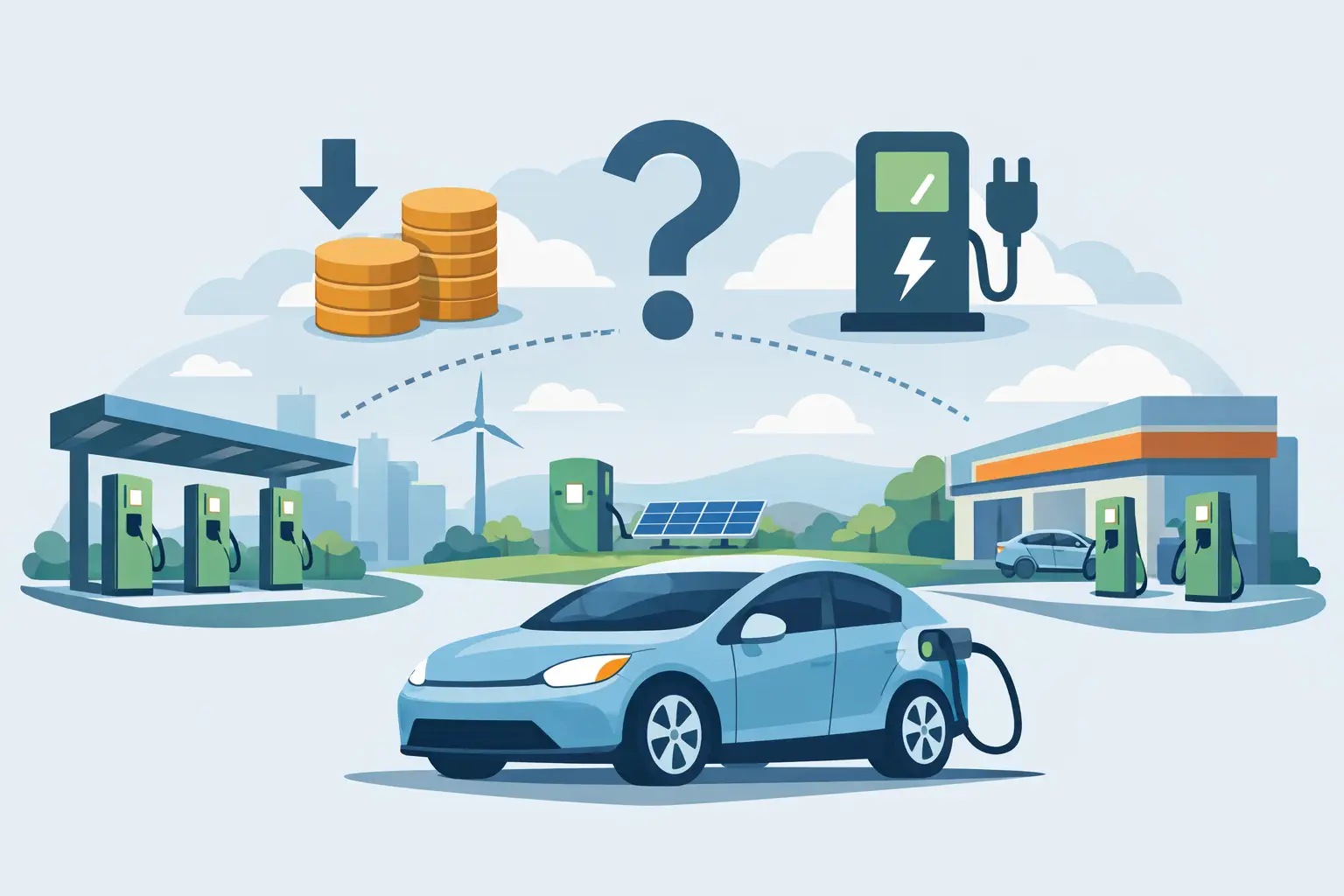
If you are searching for the cheapest ev charging network, the honest answer is not a single brand name. It changes by city, charger speed, membership status, time of day, and even how long you stay plugged in after your session is done. Drivers who learn that early usually save the most.
That is also why network marketing can be misleading. One app says its stations are affordable. Another pushes a membership discount. A third highlights fast charging but says less about idle fees, session minimums, or pricing that varies by state. If your goal is simple - find a charger nearby that will cost the least right now - you need to compare options across networks, not inside one network’s app.
What “cheapest” actually means for EV charging
The cheapest option is not always the lowest posted number. Public charging prices are messy. Some stations bill by kilowatt-hour. Others bill by time. Some add a session fee. Some offer lower rates to members. Some look cheap until you realize the charger is slow enough that you are paying with time instead of money.
For example, a low-cost Level 2 charger can be the cheapest way to add energy if you are already parked for a few hours. The same station can be a bad deal on a road trip when you need to get back on the road quickly. In that case, a more expensive DC fast charger may be the better value because it saves 45 minutes.
So when drivers ask about the cheapest EV charging network, they are usually asking one of two different questions. Which network has the lowest posted rates most often? Or which option will cost me the least for this specific stop? Those are not always the same answer.
The cheapest EV charging network by pricing model
The easiest way to compare networks is to stop thinking in brand slogans and start thinking in pricing models.
Per-kWh pricing is usually the clearest
When a station charges by kilowatt-hour, you are paying for the energy you actually receive. That makes side-by-side comparison much easier. If one station charges $0.36 per kWh and another charges $0.48 per kWh, the cheaper one is obvious before fees.
This is usually the most driver-friendly model, especially for newer EV owners. It is easier to estimate what a session will cost, and it does not punish a car that charges more slowly near higher states of charge.
Per-minute pricing can be cheap or expensive fast
Time-based pricing is where things get tricky. A per-minute charger can be a bargain if your car can hold a high charging rate for much of the session. It can also become expensive if your EV tapers early, if the charger underperforms, or if you arrive with a battery level that slows charging.
A 350 kW charger does not automatically make your session cheaper. If your car peaks at 125 kW, you are paying for access to hardware you may not fully use. In some cases, a lower-tier fast charger at a lower price delivers a better cost per added mile.
Session fees and idle fees change the math
A station with a low energy price can still be a poor value if it adds a flat session fee. That matters most for short top-offs. Idle fees matter too, especially when you are grabbing coffee or using a charger in a busy area. Stay plugged in too long after charging ends and the cheap session stops being cheap.
Why one network is rarely the cheapest everywhere
Public charging is local. Networks do not price every station the same way across the country. Site hosts, utility costs, local regulations, and competition all affect what you pay. One network may be cheap in one metro area and expensive a few states over.
That is why broad claims about the cheapest EV charging network usually fall apart in real use. Even within the same network, one station may be priced well while another nearby costs much more. Drivers who compare at the station level, not just the network level, usually come out ahead.
Memberships complicate this further. If you charge often on a single network, a monthly membership can lower your per-session cost enough to make that network your cheapest option overall. If you only fast charge on trips, the monthly fee may wipe out the savings.
Speed matters as much as price
Cheap charging that wastes your afternoon is not always a win. This is the part many apps gloss over.
A charger’s posted maximum speed is only the starting point. Your car’s charging curve, battery temperature, current state of charge, and station performance all affect what you actually get. That means the cheapest-looking station may not be the cheapest in real dollars per mile added during your stop.
Here is the practical way to think about it. If you are commuting and can plug in while shopping, a low-cost Level 2 station can be excellent. If you are traveling and need 120 miles quickly, a moderately priced DC fast charger may be the better deal than a cheaper slow option. Cost matters, but so does the value of your time.
How to compare charging costs without guessing
If you want the cheapest option for a real trip, compare four things at once: distance, price, speed, and fees. Leaving out any one of those can lead to a bad choice.
Distance matters because a cheaper charger is not really cheaper if it takes a long detour. Speed matters because a low posted rate on a slow charger can raise your total trip time more than it saves in dollars. Fees matter because they can erase small price differences. And price only matters when it is shown in a way you can actually compare.
This is where aggregator apps have an edge over network-owned apps. A network app is built to keep you inside that network. It may be useful if you already know where you want to go, but it is not built to help you compare the station down the street from a competitor. A cross-network search is simply better for price shopping because it starts from your need, not the network’s inventory.
WattsNear is built around that exact decision. Instead of asking you to pick a brand first, it lets you sort chargers by proximity and estimated cost across major networks, without forcing account creation or tracking-heavy app behavior. That is a better fit for drivers who want the answer quickly and do not care which logo wins.
Common cases where the “cheap” charger is not the best pick
A free charger sounds unbeatable, but it may be occupied, limited to customers, or slow enough that it only makes sense if you were already stopping there. A discounted membership rate sounds attractive, but it only pays off if you use that network often enough. A cheap per-minute station can look great until your battery hits a taper and your cost per added kWh jumps.
There is also the reliability trade-off. If the cheapest station has one port and a history of problems, paying a little more for a more dependable site may be the smarter move. Most drivers are not trying to win a spreadsheet contest. They want to charge and leave.
That is why the best comparison is rarely just price alone. It is price filtered through real-world convenience.
So which network should most drivers watch first?
The practical answer is all of them. Networks change prices, and local station economics change with them. Any fixed ranking gets stale fast.
What you can say with confidence is this: the cheapest EV charging network for you is usually the one that offers the lowest actual session cost at the moment you need to charge, with a speed that matches your stop and without extra fees that ruin the deal. That is a station-level decision, not a brand-level belief.
For daily use, you may find one or two local networks consistently priced better for your routes. For road trips, that pattern may disappear the moment you cross into a new region. The drivers who spend less are not loyal to one charging brand. They compare, filter, and move on.
That is the real shortcut. Do not ask which network says it is cheapest. Ask which charger, right now, gives you the best combination of price, speed, and distance. That is how you charge for less without wasting time getting there.