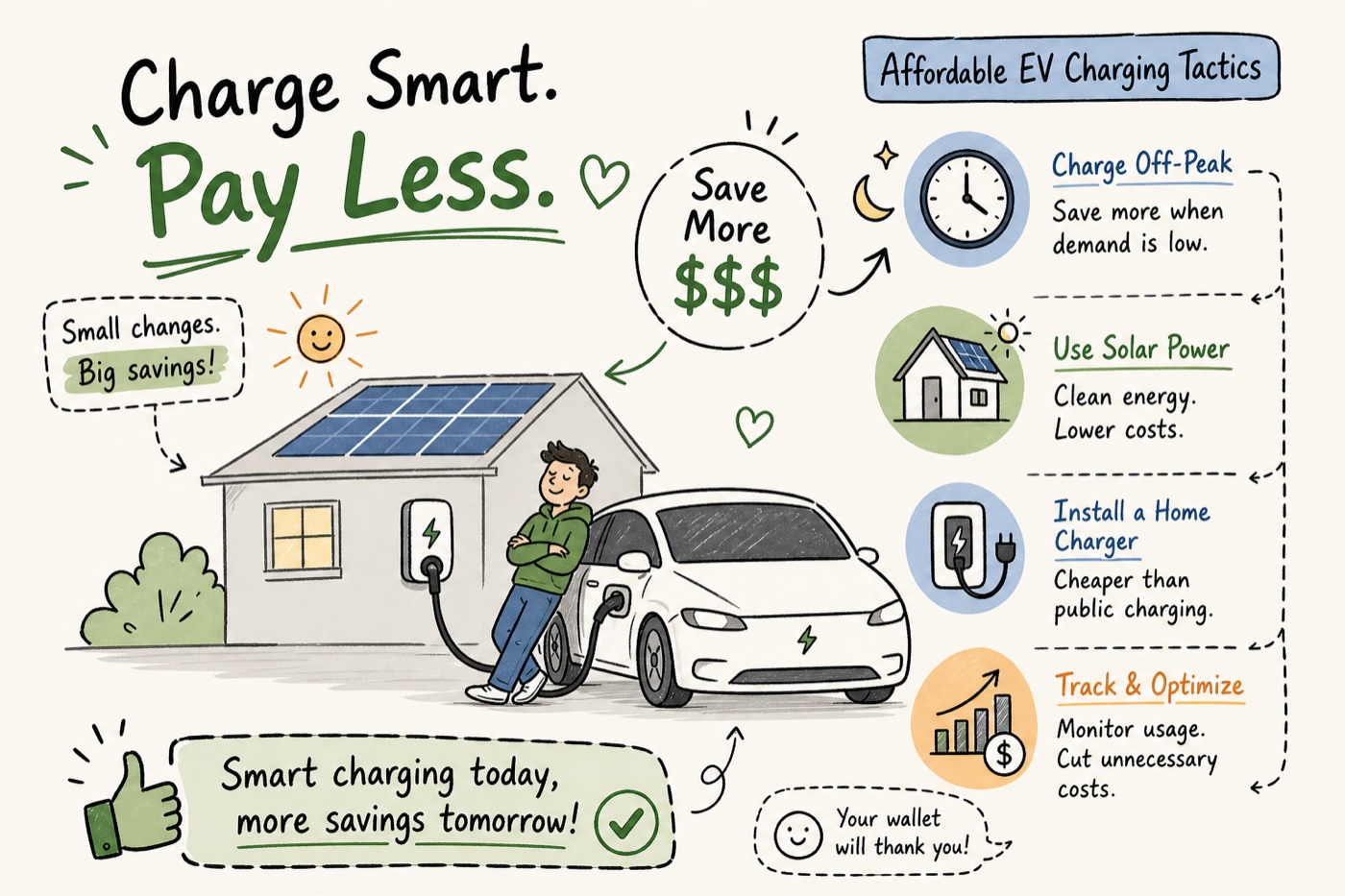
Public charging is expensive — that’s the honest starting point. The national average for DC fast charging sits at $0.45–$0.55 per kWh in 2026, meaning filling 45 kWh costs $20–$25 before session fees, parking, or the time you burned tracking down a working stall. Many EV drivers pay more than necessary. Affordable EV charging isn’t a secret: it comes down to knowing your real cost, timing your sessions, picking the right equipment, and using tools that surface the cheapest option first.
This is a practical guide. No fluff, no vague tips. It covers how to cut your per-kWh cost at home and in public, which memberships actually make sense, and how to build a weekly routine that keeps your charging bill predictable and low.
Affordable EV charging starts with knowing your baseline
The sticker price on a charger is not your real price. Your effective cost per kWh includes the energy rate, any session fee charged per connection, parking if the lot isn’t free, idle penalties if you leave the car too long, and the time spent detouring to a station that turned out to be broken. Add those up and a “$0.39/kWh” DC fast session can quietly become a $0.55 session, once you factor in the typical $1–$2 session fee, any parking cost, and lost time.
A reasonable target for 2026: keep Level 2 public charging under $0.40/kWh effective, and DC fast under $0.55/kWh. Home off-peak charging is still the floor in most states, typically $0.10–$0.20/kWh depending on your utility. If you’re paying more than those benchmarks regularly, something in your routine needs to change.
Charger type drives the biggest spread. DC fast averages $0.45–$0.55/kWh nationally, while public Level 2 runs $0.20–$0.40/kWh. Networks vary significantly: Tesla Superchargers tend to offer competitive rates off-peak, while other major networks depend heavily on your region and whether you carry a membership. Use those ranges as your reference. Any session that lands above them deserves a second look.
The daily logic is simple. Charge at home overnight for everyday miles. Use public Level 2 when you’re parking for an hour or more anyway — lunch, errands, the office. Reserve DC fast for road trips or genuine emergencies. Stick to the 10–80% charge window as your default, where charging speed is fastest and the cost per mile is lowest.
Time it right: charge when prices drop
Timing is the highest-leverage move available to most EV drivers. Tesla Supercharger rates can swing $0.10–$0.20/kWh between peak and off-peak hours at the same station. A 30-minute shift in when you plug in can cut 15–30% off your bill without changing anything else.
Home TOU plans
For home charging, the math is even cleaner. Most utilities with EV-specific time-of-use plans offer off-peak rates between $0.08 and $0.20/kWh, compared to $0.40 or more during peak hours. Xcel Energy in Colorado runs as low as $0.10–$0.18/kWh overnight. Southern California Edison’s off-peak window drops to $0.24–$0.30/kWh between 11 PM and 6 AM. Set your charger or EV to start automatically in that window and leave it alone. Precondition the cabin while still plugged in so you’re not burning stored range on heating or cooling before you leave.
Public off-peak tips
Public off-peak windows are less consistent, but early mornings, late evenings, and some midday solar windows in California and the Southwest tend to push rates down. If you’re planning a charging stop, check the network’s app before you leave. A brief delay to land in the cheaper window is almost always worth it.
Idle fees and per-minute billing deserve serious attention. On per-minute plans, the last 20% of a charge can cost nearly as much as the first 60% because the car’s charge rate tapers significantly toward full. Leaving the car plugged in after it’s done earns you idle penalties, not charge. Move promptly, stop around 70–80% on DC fast, and prefer Level 2 whenever you’ll be parked for more than an hour regardless.
Pick the right plug and stop for the job
Your connector type affects which stations are available to you and at what price. Know your car’s ports: NACS, CCS, CHAdeMO, or J1772. If your vehicle supports an adapter, carrying one expands your network access. Access to Tesla Superchargers matters because their pricing is frequently competitive, especially off-peak. Verify your adapter’s rated speed so you’re not paying DC fast rates while actually charging at Level 2 speeds.
Match the charger to the stop, not the other way around. If you’re grabbing lunch for an hour, inexpensive public Level 2 at a nearby mall or garage is almost always the cheapest option per mile. If you’re on a tight schedule and need 100 miles added fast, DC fast makes sense — but arrive with a low state of charge (around 10–20%) to spend more time in the high-power zone and less in the slow taper. Paying DC fast rates for a 15-minute top-up that Level 2 would have covered while you were parked anyway is the most common waste in public EV charging.
Battery temperature is a real cost factor that gets overlooked. Cold packs charge significantly slower, which means more time on a per-minute plan and less kWh for your money. Warm the battery by running the climate system on the plug before you leave for a charging stop. Track kWh added rather than time spent: it’s the only honest way to compare value across different stations and sessions.
Find cheap stations near you with better tools
Most EV drivers rely on a single network’s app, which by design shows you that network’s stations first. That’s not a search strategy, that’s a sales funnel. Genuinely cheap charging near you requires a price-first view across all networks and connector types at once.
WattsNear is built for exactly that. It pulls live data from the U.S. Department of Energy’s NREL database, lets you sort nearby stations by estimated price per kWh, and filters by connector type, network, charger level, and free-only status. No account required, no subscription. Find the cheapest compatible station, stop there, then log the actual cost and kWh added afterward so your history reflects what you spent, not what the sticker said.
Free and low-cost stations are more common than you might expect. Municipal parking lots, libraries, university campuses, hotels, and workplaces frequently offer Level 2 charging at no charge or very low rates. Grocery stores and shopping centers run limited-time promotions. Park-and-ride hubs can be dramatically cheaper per mile than any DC fast stop for routine errands. Build a short list of proven locations along your regular routes and save them. Use community maps like PlugShare to check reliability and read recent reviews before committing to an unfamiliar station.
Join a membership only when the math works
Memberships are worth it for some drivers and not others. The break-even is straightforward: divide the monthly fee by the per-kWh discount. If Electrify America Pass+ costs $4 per month and saves roughly $0.05–$0.11 per kWh, you need to charge 36–80 kWh per month at Electrify America stations just to break even. If you charge more than that there, pay for it. If not, skip it.
In 2026, the most common membership structures worth evaluating look like this:
- Tesla Supercharging Membership — $12.99/month for non-Tesla drivers, bringing rates down roughly 25–30% per session.
- Electrify America Pass+ — $4/month with a per-kWh discount in the $0.05–$0.11 range.
- EVgo plans — higher monthly fee, but session fees are removed and per-kWh rates drop, which helps most on short sessions where the session fee would otherwise dominate.
Frequent DC fast users on a single network tend to benefit. Occasional users often pay more in fees than they save.
Watch the gotchas. Idle fees, per-minute billing in some states, and authorization holds can quietly erase membership savings. California and the Northeast consistently run higher rates than the Midwest regardless of plan. If your travel patterns shift, cancel or pause the membership. A plan that made sense during a commute-heavy month can become a net loss during a work-from-home stretch.
Home base: set up a Level 2 charger that keeps bills low
A complete Level 2 installation in 2026 runs roughly $900–$1,200 on the low end, $1,200–$2,000 for most standard jobs, and $2,000–$4,000 or more when a panel upgrade or long wiring run is involved. Hardware for a reliable charger lands between $350 and $800 — look for affordable EVSE models with basic smart scheduling built in. The rest is labor, conduit, permits, and inspections. Siting the charger close to your panel on a short wire run is the single biggest way to keep that total down.
Get two quotes before committing. Ask each electrician whether load management hardware is an option instead of a full panel upgrade. Surface-mount conduit is cheaper than wall-fishing. Schedule the inspection promptly once work is done so you’re not paying for a return visit. Avoid charger features you won’t use: Wi-Fi scheduling and basic safety certifications are worth having; anything beyond that is cost without clear benefit for most drivers.
Stack the incentives that are still available. The federal Section 30C tax credit covers 30% of equipment and installation costs, up to $1,000, for chargers placed in service by June 30, 2026. That deadline is firm. Many utilities layer on top of that: rebates of $100–$500 for qualifying smart chargers, plus annual bill credits for enrollment in managed charging programs. Keep receipts for equipment, permits, and labor. File Form 8911 with your federal return. A $1,000 charger plus $500 installation qualifies for a $450 federal credit; add a $250 utility rebate and your out-of-pocket drops to under $800. Combined, stacking the 30C credit with available utility incentives can cut a mid-range install significantly below the sticker price.
Put it all together into a weekly routine. Charge at home off-peak on weekdays to 80%, keeping your baseline cost at the floor. Top off at a known low-cost Level 2 near work or along your regular errands if needed.
For road trips, open WattsNear, sort by cheapest DC fast along your route, and time your stops to land in off-peak windows. Log every session for a month. Drop any plan, route, or station that doesn’t beat your home per-kWh benchmark. That single habit — tracking real spend against a clear standard — will do more for your charging costs than any tip on this list. Affordable EV charging isn’t about luck or location; it’s a system, and now you have one.