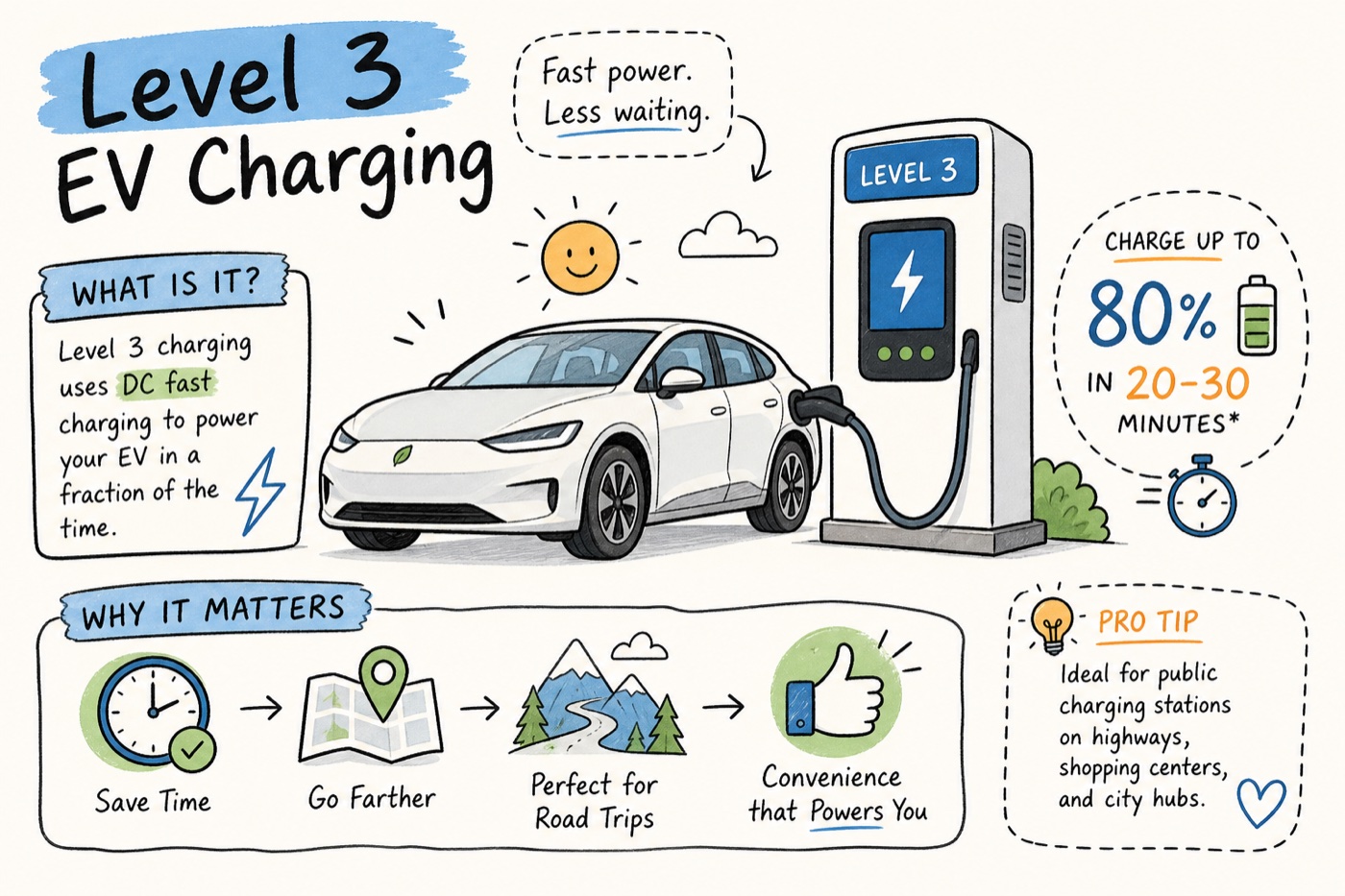
Picture this: you’re 180 miles into a highway drive, battery sitting at 20%, and you’ve got about 30 minutes before you need to be back on the road. That’s the exact scenario DC fast charging was built for. One stop, a quick plug-in, and you’re back to 80% before your coffee gets cold.
For new EV owners, the charging level system is genuinely confusing. You pull up to a station, see “Level 2” or “DC Fast” on the sign, and have no frame of reference for what that actually means in practice. The naming convention doesn’t help: “Level 3” isn’t an official industry term — agencies and automakers typically use “DC fast charging” or “DCFC” — but the label is widely understood among drivers. This guide explains what DC fast charging actually does, which cars support it, and when it’s worth seeking out over Level 2. Drivers using apps like WattsNear are already filtering for DCFC stations by distance and price before they leave the driveway, and by the end of this article you’ll understand exactly why that matters.
What Level 3 EV charging actually is
It delivers DC power directly to the battery
Every EV battery runs on direct current (DC). The problem is that the power grid supplies alternating current (AC). With Level 1 and Level 2 charging, your car handles that conversion internally using what’s called an onboard charger. It takes the AC from the outlet, converts it to DC, and feeds it to the battery. That onboard charger is the bottleneck: most handle between 7 and 11 kilowatts, which puts a hard ceiling on how fast you can charge at home or at a destination charger.
Level 3 skips that step entirely. The charging station itself converts AC from the grid into DC before it ever reaches your car, then pushes that DC directly into the battery pack. Your onboard charger is bypassed. That single difference is why DC fast charging is so much faster than anything you can do at home.
Typical power output and what it means in real time
DCFC equipment delivers between 50 kW and 350 kW depending on the unit. Think of kilowatts as the rate at which energy flows: a higher number means energy moves faster, so your battery fills up more quickly. A 150 kW fast charger can typically add 50 to 120 miles of range in about 20 to 30 minutes, depending on the vehicle’s efficiency and its maximum acceptance rate. A 350 kW ultra-fast charger, like those at Electrify America stations and newer Tesla Supercharger V4 locations, can push that even faster on vehicles designed to accept the power.
That last part matters. The actual charge speed during any session is governed by whichever is lower: the charger’s maximum output or the vehicle’s maximum acceptance rate. A 350 kW charger does nothing extra for a car that can only accept 150 kW. Always check your vehicle’s spec sheet for its maximum DC fast charge rate, not just the charger’s advertised power.
How DC fast charging compares to Level 1 and Level 2
The real-world speed difference
Level 1 uses a standard 120-volt household outlet. It adds roughly 3 to 5 miles of range per hour. Charge an EV overnight for 8 hours and you’ve gained maybe 40 miles. For everyday top-offs when you have 12 hours and a small daily commute, that’s workable. For a road trip, it’s essentially useless.
Level 2 uses a 240-volt circuit, the same voltage as a clothes dryer. It adds 20 to 40 miles per hour under typical conditions, making it the standard for home charging, hotel stays, and destination charging at shopping centers. A full charge from near-empty takes 4 to 10 hours depending on battery size and charger output. A 150 kW fast charger, by contrast, delivers well over 100 miles of range per hour for a compatible vehicle, and the top end of current hardware pushes that figure even higher. The difference between Level 2 and Level 3 on a road trip is the difference between an overnight stop and a coffee break.
Which charging level actually fits your situation
Most daily commuters never need Level 3. If you plug in at home every night, Level 2 handles the routine without any friction. Level 3 becomes the right tool on road trips, during emergency top-offs mid-route, or for drivers in apartments without home charging access who depend on fast public sessions to keep their car ready.
The honest framing: DC fast charging is a road trip tool, not a daily driver tool. Treating it like a gas station you visit every other day misses the point and, as you’ll see later, can have consequences for long-term battery health.
Which vehicles can use DC fast charging
Connector compatibility: CCS, NACS, and CHAdeMO explained
Not every EV supports fast charging, and among those that do, the connector varies by manufacturer and model year. CCS (Combined Charging System) has been the dominant standard on non-Tesla vehicles for the past several years. Cars like the Hyundai Ioniq 6, Kia EV6, and Volkswagen ID.4 all use CCS1 and support DC fast charging up to 350 kW on the right hardware. NACS (North American Charging Standard), originally Tesla’s proprietary connector, is now being adopted across the industry. Ford, GM, Rivian, Volvo, and Polestar have all moved to native NACS on recent model years, and Tesla’s Supercharger network is now open to non-Tesla vehicles with the right adapter.
CHAdeMO, once the standard on older Nissan Leafs and some Mitsubishi models, is effectively being phased out in the US. Charging stations that still carry it are becoming less common, and no major automaker is launching new CHAdeMO-compatible vehicles. If your car uses CHAdeMO, check availability along your route carefully before any long drive.
Why some EVs still can’t use Level 3
Plug-in hybrid vehicles (PHEVs) and some entry-level or older battery-electric vehicles don’t include a DC fast charge port at all. Some low-cost trims and older BEV models omit DCFC capability entirely to reduce cost — check the spec sheet or owner’s manual for your specific trim. Look specifically for the phrase “DC fast charging” or “DCFC compatible.” General marketing materials won’t always make this clear.
Where DC fast chargers are located
Highway corridors and the logic behind placement
Fast charging infrastructure is placed where range anxiety is highest: along Interstate highway corridors, near freeway on-ramps, and in towns spaced roughly 50 to 150 miles apart on major travel routes. The federal NEVI program (National Electric Vehicle Infrastructure) has been funding buildout specifically to hit a target of fast chargers every 50 miles on designated corridors. Electrify America, Tesla Supercharger, EVgo, and ChargePoint operate the largest charging networks, with Electrify America stations designed specifically for the highway corridor use case at up to 350 kW per stall.
This placement logic mirrors how traditional gas stations work for road trips, not neighborhood convenience. You won’t find a dense cluster of 350 kW fast chargers in a residential suburb. The infrastructure is built to keep long-distance travel moving. Corridors like I-95, I-5, I-10, and I-80 now have reasonably consistent coverage, with 20 to 50 miles between stations on most segments.
Urban and suburban fast charger availability
Beyond highways, fast chargers are appearing at large retail centers, grocery stores, and transit hubs in high-EV-adoption metros like Los Angeles, Seattle, Austin, and Miami. These urban fast chargers serve drivers who need a quick charge between errands rather than a dedicated road trip stop. Coverage is still uneven nationally, and rural areas remain genuinely underserved in many regions. The density in major metros is growing fast, but if you live outside a high-adoption area, checking station availability before planning a longer drive is worth the two minutes it takes.
When to seek out a fast charger, and when to skip it
Road trips, tight schedules, and emergency top-offs
The strongest case for DC fast charging is a long-distance trip where stopping time matters. A 20-minute fast charge during a rest stop keeps momentum without turning a drive into an all-day affair. It also makes sense for urban drivers without home charging who need a quick refill between shifts. One practical rule worth locking in: charge to 80%, not 100%, at fast chargers. Most EVs taper their charge rate significantly above 80% — a behavior built into the charge curve to protect the battery — which means the last 20% of a full charge can take as long as the first 80%. Getting to 80% and getting back on the road is almost always the efficient move.
What regular fast charging does to battery longevity
Frequent DC fast charging at high power generates more heat than Level 2 charging, and heat is the main driver of long-term battery degradation. Fleet data from operators like Recurrent Auto suggests the real-world impact is modest: roughly 0.1 to 3% extra capacity loss per year in the worst cases, and statistically negligible for drivers who use fast charging occasionally. Modern EVs include thermal management systems specifically to mitigate this, and occasional fast charging on trips is completely fine for a well-managed battery.
A common rule of thumb across owner manuals from automakers like Tesla and Hyundai: rely on Level 2 for 80% or more of your charging, and reserve DC fast charging for travel and emergencies. Charging fast a few times a month won’t hurt a modern battery. Charging fast every single day for five years is a different story. Use the right tool for the right job and your battery should last well over a decade without significant capacity loss.
Finding the fastest and most affordable Level 3 stop on your route
Why not all fast chargers cost the same
DC fast charging prices vary widely across networks, locations, and states. Some networks charge per kilowatt-hour, others per minute, and a handful of locations are still free. A 150 kW charger at Electrify America in California will likely cost more per session than a comparable stop at a regional network in Texas. Per-minute pricing models also disadvantage vehicles with lower acceptance rates, since a car charging at 75 kW on a per-minute rate costs the same as one charging at 150 kW. Without visibility into pricing before you arrive, it’s easy to pull into the most expensive station on the corridor simply because it’s the first one you see.
Filtering and sorting stations by distance and price
WattsNear pulls live station data and lets you filter specifically for DC fast chargers, then sort results by distance or estimated price per kWh. Before leaving on a trip, you can scan the DCFC stops along your route, compare costs between charging networks, and save the best options to your Favorites for quick access on the road. The app also works hands-free via Apple CarPlay, so you’re not reaching for your phone mid-drive to find the next stop.
For drivers who make longer trips regularly or live without home charging access, having that kind of sorted, filtered view of nearby fast chargers is a genuine time and money saver. Pricing differences between networks can be substantial — sometimes tens of dollars per session depending on the network, state, and billing method — and those costs add up quickly over a year of road trips.
The bottom line on Level 3 charging
Level 3 EV charging delivers DC power directly to the battery, bypassing the onboard charger and enabling charge speeds that compress what would take hours on Level 2 into under 30 minutes. It requires a compatible DC fast charge port and the right connector for your vehicle: NACS on most new models, CCS1 on older non-Tesla vehicles, and CHAdeMO on a shrinking list of legacy cars. Public DC fast chargers are concentrated along highway corridors and high-traffic urban sites — they’re designed to support travel, not replace home charging.
New EV owners don’t need to fear fast charging, but they don’t need to seek it out for every session either. Use Level 2 at home for the daily routine, and reach for DC fast charging when the road demands it. Your battery will hold capacity longer, and your charging costs will reflect the difference. Before your next long drive, take five minutes to check which Level 3 stations sit along your route and what each one costs. Knowing that in advance takes the guesswork out of the drive and the anxiety out of the range.